The events recorded in both the Bible and Natural
History become more vivid when we learn something of both the land and the
times of the World. Once we become conscious of the geographic setting and
the historical background of human development, not only do the Sacred Scriptures
take on new meaning and interest, but also how civilisations grow and die.
The maps have been compiled and assembled to show the cultures of the ancient
Near East. The vineyard-covered hills around the Sea of Galilee, the inhospitable
wastes of Sinai and the fertile alluvial plains of Babylon become more familiar
and real taking in the length of time. Ancient Biblical cities, some with
a grand and continuing history, others whose fame was bright but short-lived,
take their proper places within the crowded, ever-changing framework of tiny
states and vast empires. Illustrations from the wealth of archaeological finds-primitive
farm and household implements, ruined walls of forts and stables, and the
amazing monuments that served as palaces and tombs to the great kings-all
help to evoke a feeling for the places, peoples and events of Time.
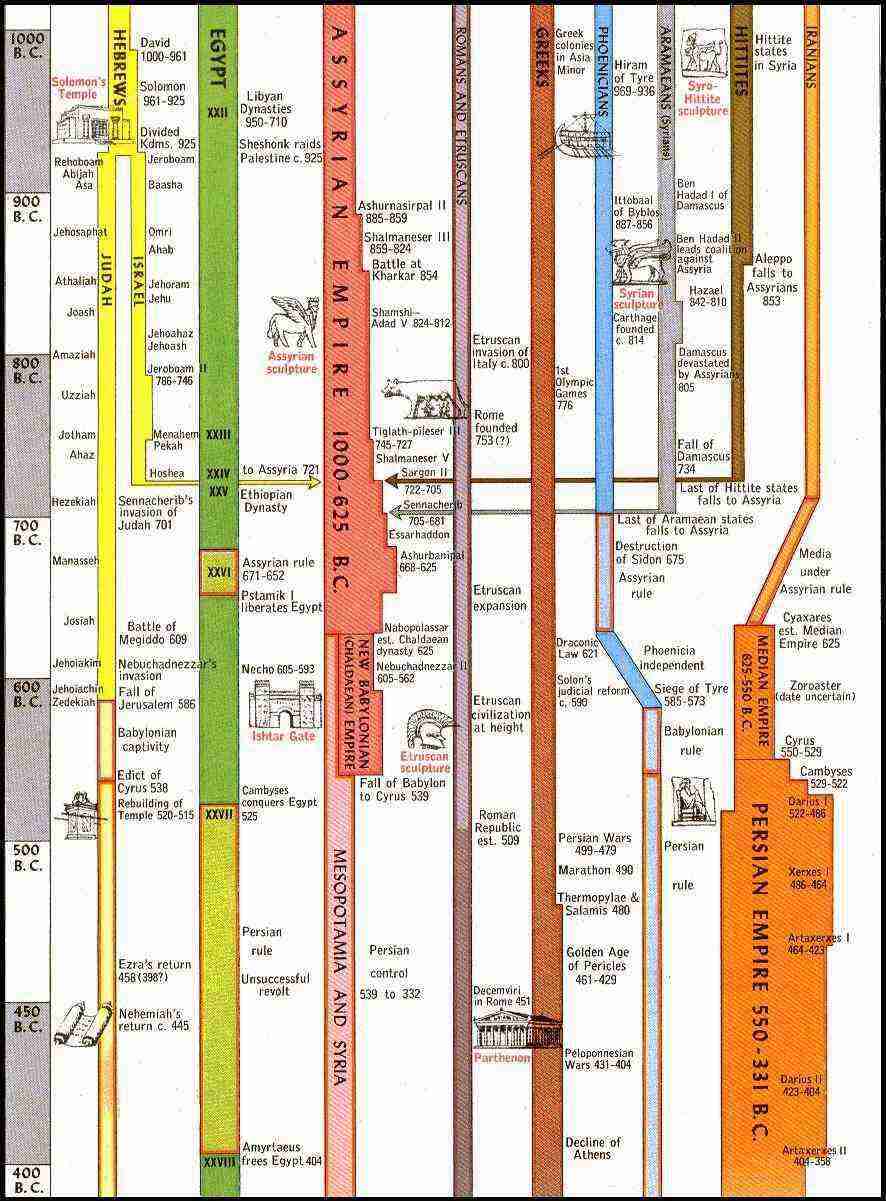
This chart traces the progress of nations and peoples of the Bible from the
last years of the Stone Age down through recorded history to the beginning
of the Christian era. At a glance, the reader can obtain a picture of developments
in all parts of the Historical and Biblical world during a particular period
in history. The dates of important events and historical figures, along with
helpful illustrations, are placed next to the colored column representing
a specific people. The formative stage of a people's development, before national
status is achieved, is shown by a lighter shade of color. In times when political
control passes to a conquering state, the same lighter shade of color appears
enclosed In bands of color of the ruling power. When a nation disappears from
the stage of history, or more accurately, when it no longer retains its separate
political or cultural individuality, the column merges into that of the conquering
group. Changes due to territorial expansion or decline are indicated by the
varying width of the colored column. Although the widths of the columns only
approximate the territory held by a nation, they do serve to give a comparative
picture of each nation's importance in the ancient world.
What, then, is the historical pattern that unfolds from the chart? Starting
with those two centers of ancient civilization, Egypt and Babylonia, we can
see the development of powerful kingdoms while the Hebrews were still a wandering
pastoral people. A glance to the right on the chart brings into focus the
emerging cultures of the Minoans of Crete and the Hittites in Asia Minor.
By the time of the Exodus of the Israelites from Egypt, Babylon has yielded
to the Assyrians and the Hittites had forged an empire which clashed with
that of Egypt under Rameses II in the battle of Kadesh. Another, more famous
encounter, the one that took place before the walls of Troy, occurs a century
later while the Israelites are still trying to make a home in Canaan. It is
here, with the heroes of Homer and the emergence of the Greek city-states,
that the history of western civilization begins. The year 1000 B.C. finds
a unified Hebrew kingdom of David and Solomon alongside the friendly Phoenician
city-state of Tyre and antagonistic Aramaean kingdoms in Syria.
Then Solomon's kingdom is divided and the two units continue until Israel
is erased by the Assyrian armies. The remaining Jewish people are all but
lost in the changing empires that succeed the overgrown Assyrian state. By
now the Hittites are but a memory. The Median and Chaldaean empires are relatively
short lived as Persia emerges as the power of the ancient world. Only the
Greeks remain free to defy the Persian rulers of the next two centuries. Greek
influence both preceded and followed Alexander and his army into Asia, but
his early death lost for Greece the chance to rule a world empire. Again the
east is divided into kingdoms and a new list of monarchs appears-Seleucus,
Antigonus, Ptolemy.
In the west, the year 300 B.C. shows a growing Roman Republic embarked on
the subjugation of Italy. By the time of the Maccabees, the Holy Warriors
who restored political control of Palestine to the Jews, Rome has expanded
beyond Italy to embrace the lands of conquered Carthage and Greece. Roman
penetration into the eastern Mediterranean countries actually aided the Jews
in their war with the Seleucids, but the legions of Pompey did not stop at
Antioch. Jerusalem was to hear more than once the clank of Roman arms and
armor. The Jewish state may have had its strong-willed Herods, but ultimate
authority rested in Rome. Only the Parthians with their mounted archers could
successfully challenge the might of Rome. The dramatic story of Christ's life
and the subsequent establishment of a new faith based on His teachings unfolds
against a backdrop which is dyed in imperial purple. The last struggles of
the Jews to win their freedom from Rome were desperate attempts doomed to
failure. The Jewish people were denied political control in any part of Palestine
from then on until the establishment of the State of Israel in 1948.
The chart ends at 150 A.D. During the following centuries, Roman power was
to wane and finally disappear, but the two beliefs Rome sought to erase lived
on and spread. The Jews, their Temple destroyed and Jerusalem denied them,
dispersed throughout the world, taking their faith with them. The rising Christian
Church expanded throughout the Roman Empire, making converts of its subjects,
later its emperors, and eventually converting even its Barbarian conquerors.TOP..
Return